Complete lesson · Facial Recognition

Exploring Facial Recognition with Cece

Students discover how facial recognition works, measure and compare facial features in a hands-on mystery, and weigh the privacy trade-offs of the technology - a one-hour, cross-curricular lesson for Grade 3.

Grade 3 · adaptable 3–5 60 minutes Cross-curricular Works offline

Is this right for my class?

Grade & subject

Written for Grade 3 (adaptable across grades 3–5). Cross-curricular: ELA reading, math measurement, science (inherited traits), and digital citizenship.

Time & prerequisites

One 60-minute session. No prior AI experience needed. Best after the Intro to AI lesson, but it also stands alone.

Devices & internet

Optional. The full lesson can run with only printed materials, pencils, and rulers. A projector helps for the video and the optional Kahoot quiz.

What students will learn

Essential question: How can a computer recognize a face, and how do we use that technology responsibly while protecting people's privacy?

By the end, students can

  • Explain that facial recognition identifies people by analyzing unique facial features.
  • Give everyday examples of where facial recognition is used.
  • Measure and compare facial features in a hands-on investigation.
  • Describe what digital privacy means and ways to protect personal information.
  • Weigh the benefits and the concerns of the technology.

Big idea

Identity, privacy & responsible technology. Facial recognition shows how AI can use information about people's physical characteristics to identify them - which is useful, but also raises real questions about privacy and consent.

Prepare & materials

Required (works offline)

  • Printed copies of the Cece story (one per student or pair).
  • The facial-features investigation worksheet, plus rulers and pencils.
  • Benefits-vs-concerns sorting cards (cut from the worksheet pack).
  • The printable Exit Ticket, one per student.

Prep time: about 15 minutes to print and cut.

Optional (needs devices)

  • Projector + the Facial Recognition video guide.
  • A Kahoot quiz for the review (the Exit Ticket is a paper alternative).
  • Design tools (Keynote, Pages, or Freeform) for the Privacy Awareness Campaign extension.

Teaching sequence

Seven steps that add up to one 60-minute class. Times include transitions.

  1. Introduction to facial recognition (5 min) - hook students with where they already meet the technology.
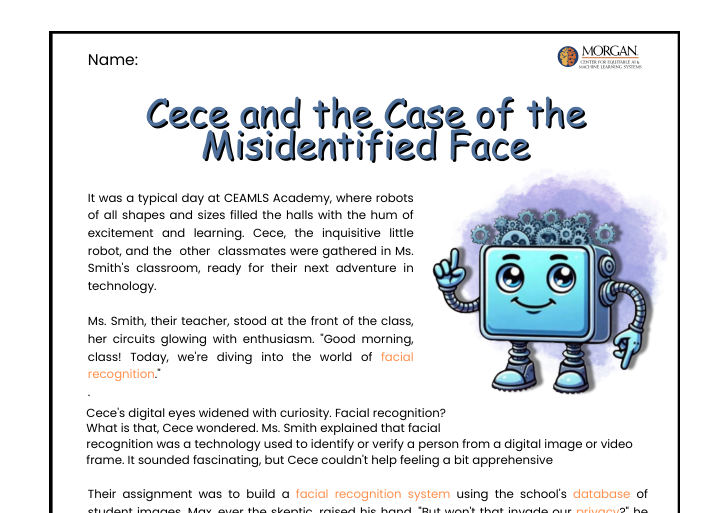
  2. Read "Cece and the Curious Case of the Misidentified Face" (10 min) - the story introduces the vocabulary in context.
  3. Hands-on: investigating facial features (15 min) - students measure and compare features on the worksheet grid, simulating how a system compares data points.
  4. Real-world applications & discussion (10 min) - where is it used, and who benefits?
  5. Sorting activity: benefits vs. concerns (10 min) - students place cards and defend their choices.
  6. Kahoot quiz, or the paper Exit Ticket (5 min) - quick review.
  7. Closing discussion & reflection (5 min) - should this technology be used here, and how do we protect privacy?

Total: 60 minutes.

Want more? The teaching guide also includes a longer Challenge-Based Learning version - Engage, Investigate, Act - that spreads the same ideas across two to three sessions and ends with students creating a Privacy Awareness Campaign. Use it as a multi-day project rather than a single class.

Assessment

Along the way (formative)

  • Story discussion and a facial-recognition vocabulary check.
  • Student explanations of benefits and concerns during the sorting activity.

At the end (summative)

The included Exit Ticket asks students to define facial recognition, give an example, and name one privacy protection. A Kahoot quiz is an optional digital alternative.

Open the Exit Ticket ↗

Differentiate & extend

Support

  • Read the Cece story aloud, or use the read-aloud pacing in the guide.
  • Provide sentence stems for the benefits-vs-concerns discussion.
  • Pre-mark the measurement points on the investigation grid.

Stretch

  • Research one real place facial recognition is used and its privacy trade-offs.
  • Run the Challenge-Based Learning extension and build a Privacy Awareness Campaign.

What's included

Download everything at once, or grab the pieces you need. All files are PDFs unless noted.

Download the complete lesson (.zip)
  • Teaching guide - the full lesson plan, standards, and agenda. Open ↗
  • Cece story - "Cece and the Curious Case of the Misidentified Face." Open ↗
  • Student worksheet - the facial-features investigation. Open ↗
  • Exit ticket - the end-of-lesson check. Open ↗
  • Library workshop resources - extra facilitator notes. Open ↗
  • Video guide - the facial-recognition demonstration. Open ↗

Standards referenced

CCSS ELA-Literacy (Grade 3 reading & writing), CCSS Math 3.MD.B.4, NGSS 3-LS3-1, CSTA (1A/1B data & networks), and ISTE 1.2 Digital Citizen. These are referenced in the lesson; confirm the exact alignment for your curriculum before formal planning.

© 2026 Morgan State University. Free to download and use in your classroom. Version 2026. Questions or want to adapt and share it more widely? k12ceamls@morgan.edu.