Complete lesson · Neural Networks

Exploring Neural Networks with Cece

Students act out how a neural network passes information along, then build a maze game in Scratch - a one-hour, hands-on lesson for Grade 3.

Grade 3 · adaptable 3–560 minutesCross-curricularOffline options

Is this right for my class?

Grade & subject

Written for Grade 3 (adaptable across grades 3–5). Cross-curricular: ELA discussion and vocabulary, plus computer science.

Time & prerequisites

One 60-minute session. Best after the Machine Learning lesson, but it also stands alone.

Devices & internet

Partly. The story, the Neural Network Relay, and the discussion run offline. Maze Craze in Scratch and Kahoot need devices.

What students will learn

Essential question: How does information travel through a neural network to help a computer make a decision?

By the end, students can

  • Explain that a neural network passes information through connected layers.
  • Describe how each step passes a signal toward a decision.
  • Model information flow in the unplugged Neural Network Relay.
  • Build and test a simple maze game in Scratch.
  • Connect the activity back to how computers make predictions.

Big idea

Layers working together. A neural network hands information from one layer to the next, and the whole chain - not any single part - produces the answer.

Prepare & materials

Required (works offline)

  • Printed copies of the Cece neural-network story.
  • Space and simple props for the Neural Network Relay (an unplugged team activity).
  • The printable Exit Ticket, one per student.

Prep time: about 15 minutes to print and set up the relay.

Optional (needs devices)

  • iPads or computers with Scratch for Maze Craze.
  • A Kahoot quiz for the review.
  • Projector for the whole-class discussion.

Teaching sequence

Six steps that add up to one 60-minute class. Times include transitions.

  1. Introduction to neural networks (5 min) - share the objectives and hook students.
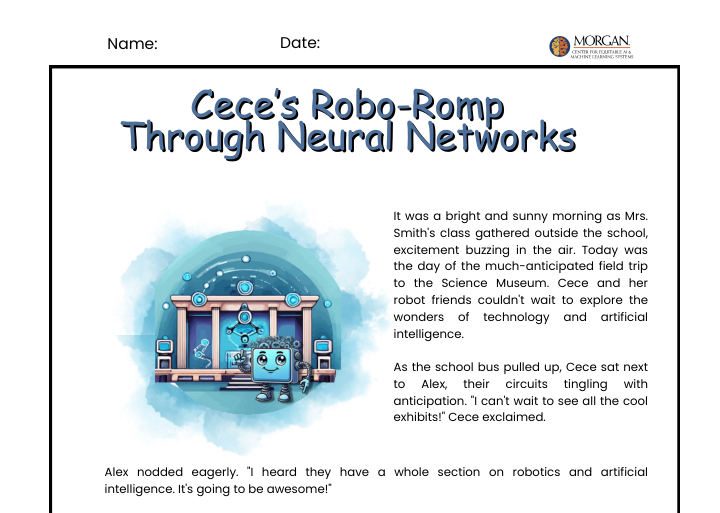
  2. "Cece's Robo-Romp Through Neural Networks" (10 min) - the story introduces the idea.
  3. Neural Network Relay (10 min) - an unplugged activity where students pass a signal along, layer by layer.
  4. Discussion (5 min) - what happened as the message moved through the team?
  5. Maze Craze with Scratch (25 min) - students build and test a simple maze game.
  6. Kahoot quiz, or the paper Exit Ticket (5 min) - quick review.

Total: 60 minutes.

Want more? The teaching guide includes a longer Challenge-Based Learning version (Engage, Investigate, Act) for a multi-session Scratch project.

Assessment

Along the way (formative)

  • Story discussion and vocabulary check.
  • Observing the relay and students' explanations of information flow.

At the end

The included Exit Ticket asks students to explain how information travels through a neural network. A Kahoot quiz is an optional digital alternative.

Open the Exit Ticket ↗

Differentiate & extend

Support

  • Read the story aloud.
  • Assign clear roles in the relay.
  • Provide a Scratch starter project for Maze Craze.

Stretch

  • Add more layers or rules to the Scratch maze.
  • Run the Challenge-Based Learning extension.

What's included

Download everything at once, or grab the pieces you need. All files are PDFs.

Download the complete lesson (.zip)
  • Teaching guide - the full lesson plan, standards, and agenda. Open ↗
  • Cece story - "Cece's Robo-Romp Through Neural Networks." Open ↗
  • Exit ticket - the end-of-lesson check. Open ↗
  • Intro script - a facilitator script for the opening. Open ↗
  • Resources - facilitator resources. Open ↗
  • More resources - additional neural-network resources. Open ↗

Standards referenced

CCSS ELA-Literacy SL.3.1 (collaborative discussion) and L.3.5 (word relationships), plus NGSS, CSTA, and ISTE connections. These are referenced in the lesson; confirm the exact alignment for your curriculum before formal planning.

© 2026 Morgan State University. Free to download and use in your classroom. Version 2026. Questions or want to adapt and share it more widely? k12ceamls@morgan.edu.